Key takeaway
Golden Mile Complex, also known as Singapore’s “Little Thailand,” is a striking example of Brutalist architecture and a pioneer in mixed‑use megastructures. Built in 1973, it brought together shopping, offices, and homes in one stepped concrete form. In 2021, it became the first large‑scale strata‑titled building in Singapore to be gazetted for conservation. Its future redevelopment seeks to balance heritage with new uses, preserving both its bold structure and its role in Singapore’s social fabric, while setting a benchmark for adaptive reuse of post-independence megastructures.
Between Beach Road and Nicoll Highway stands Golden Mile Complex, a building that once felt like a vertical city, full of life, color, and energy. For decades, it earned the nickname “Little Thailand” because of its many Thai shops, restaurants, and tour agencies. But beyond the bustle, this building is also a serious architectural statement: Singapore’s first big Brutalist megastructure that is now conserved. So how did this concrete giant get its name, why is it so important, and what’s next for it? Let us walk through its story.
The Birth of a “Vertical City”: Golden Mile Complex
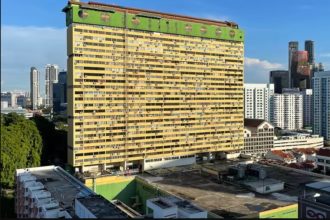
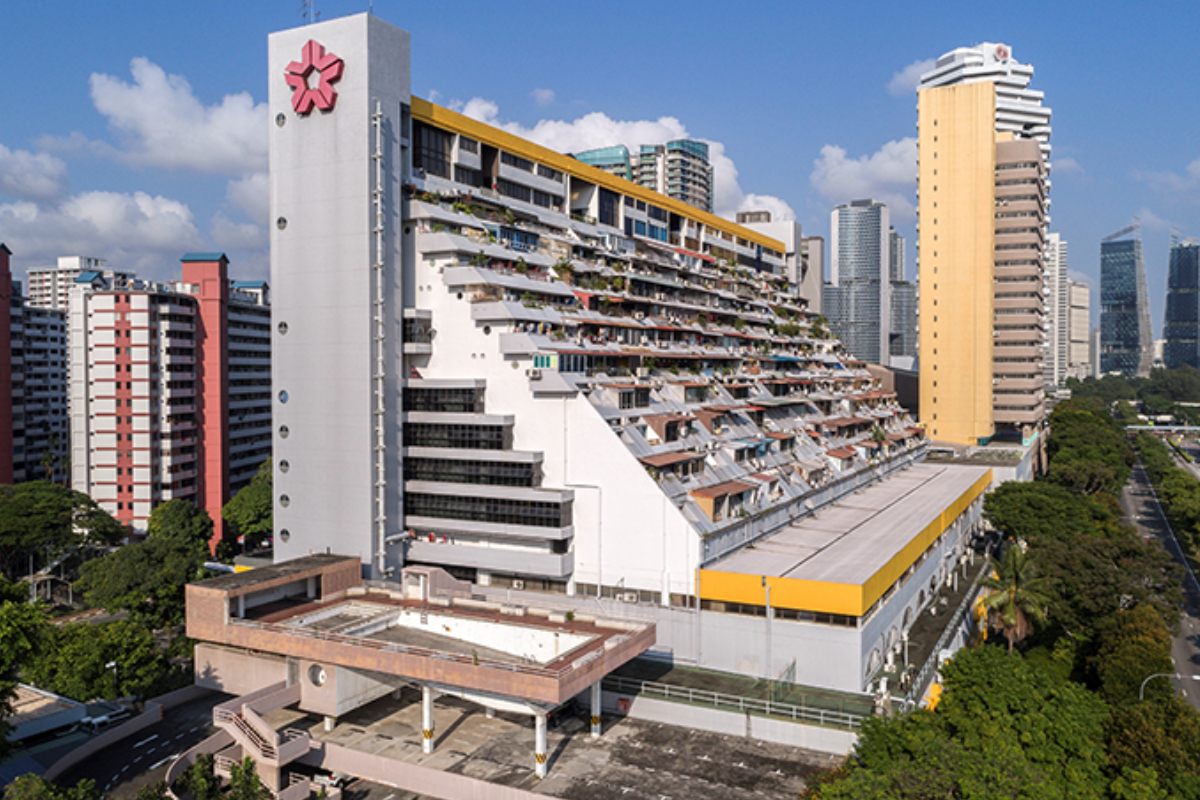
The Golden Mile Complex opened in 1973. It was designed by Singapore’s Design Partnership, led by Tay Kheng Soon, William S.W. Lim, and Gan Eng Oon. The site covers around 1.3 hectares, and the building rises to about 89 metres tall over 16 storeys. It was conceived as a megastructure, a self-contained vertical city where people could live, work, shop, and relax, all in one building. At a time when Singapore was still young as an independent nation, the project symbolized a forward-looking approach to urban density, combining residential, commercial, and office spaces within a single footprint. This bold planning concept set a precedent for future mixed-use developments in Singapore.
Golden Mile Complex shares its early mixed-use vision with Singapore’s first shopping atrium, People’s Park Complex. Both projects integrated retail and community spaces, providing Singaporeans with multi-functional urban environments before this approach became common. These developments highlighted the potential for urban spaces to go beyond functional uses and serve as social and cultural hubs.
Why “Little Thailand”?
Over time, the retail podium became home to many Thai businesses. Cheap Thai food, grocery shops, tourist agencies, and informal bars all clustered there. For Thais living in Singapore, the Golden Mile Complex offered a slice of home. This social hub mirrors the vibrancy found at the largest hawker centre, Chinatown Complex, where food culture creates a communal experience. Beyond commerce, the building became a meeting point for cultural exchange, festivals, and community activities, hosting celebrations such as Songkran (Thai New Year) and Loy Krathong festivals. These cultural layers add depth to the building’s identity beyond its architectural form.
Brutalism Meets Megastructure
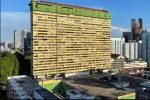
The building’s form is unmistakable: stepped terraces, a slanted atrium, and a raw concrete finish. These features were not just aesthetic. They were functional. The stepped terraces maximize natural light and allow for private, open-air balconies. The sloped design also encourages cross-ventilation, which was particularly important in Singapore’s tropical climate before air-conditioning became ubiquitous in commercial spaces.
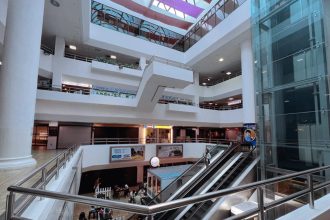
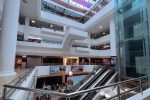
Inside, a sloping atrium connects different levels. Originally, the atrium was meant to run up through the whole height, promoting ventilation, daylight, and a sense of community across floors. Despite modifications for fire safety, the atrium still acts as the building’s social spine, where shoppers, office workers, and residents intersect. Small cafés and shops along the atrium encourage lingering, making it more than just a passageway. This sense of movement and interaction reflects the “vertical city” ethos envisioned by its architects.
Engineering Ambition
Engineering this structure was no small feat. The building’s sloped terraces and voids required careful calculations. It was built with the help of Arup, using early computer design to model the structure. The result was a bold demonstration of innovation for its time. Its design incorporated precast concrete panels and cantilevered floors, which allowed the building to step outwards at higher levels. This not only gave it its distinctive profile but also maximized usable floor area for commercial purposes while keeping communal terraces.
The Road to Conservation
By the 2010s, the Golden Mile Complex had become run-down. Some of its terraces were enclosed in zinc or patchwork cladding, and parts of the building looked neglected. But many saw its value beyond the decay, recognizing it as a rare surviving example of post-independence modernism and a unique vertical community.
On 22 October 2021, it was officially gazetted for conservation by the Urban Redevelopment Authority (URA). That made it the first large-scale, strata‑titled, mixed-use building in Singapore to receive such protection. The conservation plan encourages retention of its distinctive Brutalist form while allowing sensitive redevelopment. Incentives include bonus floor area and a fresh 99-year lease for developers, making it both a heritage project and a viable commercial investment.
What Makes It a National Treasure?
- Architectural significance: A rare, realized megastructure in Southeast Asia.
- Social value: A gathering place for Thai‑Singapore communities.
- Historical role: A post‑independence experiment in urban density and mixed use.
- Engineering innovation: Sophisticated structural design for its time.
- Cultural vibrancy: Host to festivals, small businesses, and community activities.
The Golden Mile Complex Today and Tomorrow
After its sale in May 2022 to a consortium (Perennial Holdings, Far East Organization, and Sino Land), the building was rebranded as The Golden Mile. The plans call for four new office storeys on the conserved structure, plus a 45‑storey residential tower called Aurea, linked by a sky bridge. This redevelopment demonstrates how conservation and contemporary urban demands can coexist in a single project.
Work is underway to restore key Brutalist elements: the stepped terraces, the mosaic floors, the oculus motifs, and the atria. An architecture centre is planned to open by Q3 2029, which will serve as a hub for public engagement and education about modernist architecture. The redevelopment also aims to create more public spaces and landscaped areas, bridging the building’s original vision of communal living with modern urban needs.
Challenges Ahead
As the building transitions, some worry. The Thai businesses that gave it its “Little Thailand” identity were asked to leave by May 2023. Will the community spirit survive redevelopment? Architecturally, too, there is debate. The four added floors are meant to be distinct, but can they feel like part of the same building? Future occupancy, usage patterns, and visitor engagement will determine whether Golden Mile Complex continues to function as a living, breathing vertical city or becomes a heritage landmark frozen in time.
Community and Cultural Legacy
Beyond architecture, the Golden Mile Complex has been central to social history. Many migrant workers and small business owners started here, creating networks that shaped Singapore’s labor and retail scene. The building’s podium became an informal gathering space where language, food, and customs mixed. It was a site of mentorship, business incubation, and social support, giving the building a life beyond concrete. Preserving these intangible aspects of community memory is as important as conserving its physical form.
Golden Mile Complex: Its Influence on Modern Urban Design
The Golden Mile Complex influenced subsequent urban developments. Its vertical integration model inspired later mixed-use projects, including the OCBC Centre. Architects and planners took note of how it combined retail, office, and residential spaces efficiently. Today, the principles of shared communal spaces, terraces, and atria echo in newer developments across Singapore, reflecting the lasting legacy of its design philosophy.
How Golden Mile Complex Shapes Singapore’s Built Heritage
Golden Mile Complex stands at a crossroads. It is a symbol of Singapore’s architectural ambition, and of a socially vibrant, cross-cultural hub. Conserving it does more than preserve concrete and glass. It preserves stories, memories, and an experimental spirit. It is a clear example of Brutalist architecture in Singapore, showing how heritage and urban life can coexist in one building. For readers curious about Brutalism worldwide, Brutalist architecture provides a comprehensive reference on the movement that inspired projects like the Golden Mile.
- It challenged conventional planning by blending uses long before mixed-use was trendy.
- It pushed engineering limits with its stepped terraces and sloping atrium.
- It served a real community, not just residents, but foreign workers and small businesses.
- It tested conservation frameworks for post‑independence modern buildings on a large scale.
- It continues evolving, offering a model for adaptive reuse that respects history and serves today.
A Quick Look: Key Facts About the Golden Mile Complex
| Building | Key facts | Nearest MRT | Sources |
|---|---|---|---|
| Golden Mile Complex | 16 storeys, ~ 89 m tall, completed in 1973; gazetted for conservation in 2021 | Nicoll Highway / Esplanade MRT (approx) | Docomomo SG |
Where the Heart of Little Thailand Meets Concrete Vision
Golden Mile Complex is not just a monument in Singapore’s skyline. It is a living link between bold architectural thinking and a working‑class community. It is Singapore’s first conserved megastructure. Its layers tell stories of Thai hawker stalls, experimental architecture, and a future where heritage and innovation find each other. That is the power of Singapore’s Little Thailand and its first conserved Brutalist megastructure.