Key takeaway
The Colonnade in Singapore is Paul Rudolph’s bold concrete vision made real, a sculptural residential tower literally lifted off the ground by two closely-spaced rows of columns. Its design gives each unit dramatic double-height living rooms, generous terraces, and shifting floor planes that respond to Singapore’s climate and light. What appears as raw concrete strength is a carefully crafted, human-centered place to live.
More than an architectural curiosity, the tower stands as an experiment in how high-density urban housing can still feel spacious, breathable, and deeply connected to its surroundings. Few buildings in Singapore combine expressive form with such livable spaces, making it a rare example of modern tropical brutalism that still feels inviting rather than austere.
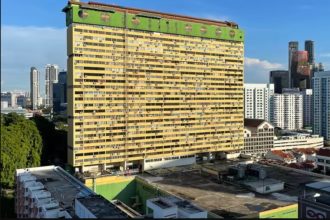
In the quiet green enclave of Grange Road, The Colonnade stands like a gravity-defying sculpture. Designed by Paul Rudolph, this concrete tower seems to float above the ground, carried by evenly spaced columns, a literal colonnade. But behind the dramatic form is a thoughtful, climate-conscious design that makes each home feel both generous and intimate. Its innovation recalls Singapore’s early experiments in mixed-use design, similar to the first shopping atrium that set a precedent for urban residential-commercial integration.
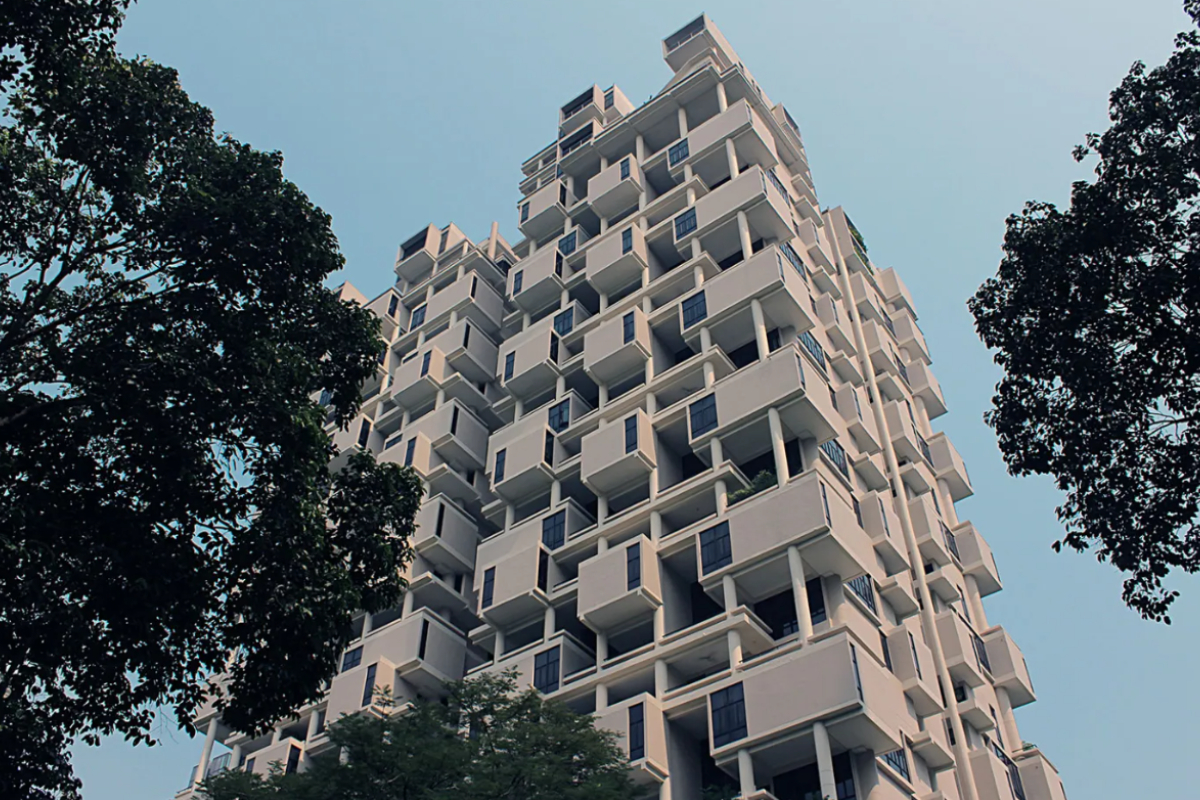
As the neighbourhood evolved from low-rise bungalows to a premium residential district, The Colonnade retained a unique personality. Its façade of alternating terraces, voids, and projecting quadrants stands out in a sea of glassy contemporary towers. Even today, the building captures attention for its sculptural massing and its refusal to blend in — a deliberate move by Rudolph, who believed that architecture should “provoke curiosity” through rhythm and complexity.
Why call it “lifted by double rows of columns”?
The name “Colonnade” is no accident. Rudolph raised the four quadrants of the tower on two closely spaced rows of round concrete columns. This creates open space underneath, letting light and air flow freely, a practical move for Singapore’s tropical climate.
This elevated ground plane also acts as a dramatic arrival sequence for residents. Instead of walking into a heavy tower, residents enter through a breezy open plaza shaded by the building above. The experience mirrors Rudolph’s fascination with “processional movement,” the idea that the journey into a building should feel dynamic, layered, and shifting in perspective.
How the design reflects Paul Rudolph’s vision
Rudolph originally imagined stacking prefabricated units, a modular system he called “twentieth-century brick.” When prefabrication proved too costly, he switched to poured concrete. Still, the building retains a modular feel, with bold geometry and strong structural rhythm. This approach aligns with other Singapore residential innovations, such as the First Valley condominium, which experimented with terrain-based unit planning.
His early sketches reveal a fascination with “inhabited structural frames,” buildings where the load-bearing system doubles as sculptural expression. The Colonnade displays this ambition clearly: its columns, slabs, and quadrants are not hidden but celebrated, allowing residents to live inside a visibly expressive structure that still feels warm and intimate.
Four quadrants, shifting floor planes
The floor plan is divided into four rectangular quadrants, arranged around a central core. Each quadrant sits at a different height above ground, giving a sense of movement and variation — something Rudolph explored throughout his work. The concept of innovative residential forms is also echoed in the horseshoe tower design of Pearl Bank Apartments, which redefined high-density urban living.
The shift between floor levels also creates terraces that are generously sized compared to other high-rise homes of the era. These outdoor spaces are partly sheltered, partly exposed — a deliberate blend intended to capture breezes and filter sunlight. The resulting façade is a rhythmic stack of projecting volumes and recessed shadow lines, giving the tower its distinctive sculptural depth.
Living in the sky: the units and internal layout of The Colonnade
The homes inside The Colonnade are as dramatic as the building itself. Each unit is two storeys high. The lower level typically has an open living and dining area, a large kitchen, and a terrace. Upstairs, you’ll find two larger bedrooms. The double-height living spaces and expansive glass allow for abundant natural light.
Due to the building’s quadrant-based structure, units often have corner-like orientations even when positioned mid-tower, resulting in cross-ventilation and multi-directional views. Many residents describe the interiors as “loft-like tropical homes,” a rare hybrid of New York-style vertical living and Southeast Asian openness.
Adapted to the climate
Rudolph’s design takes Singapore’s sunshine seriously. He oriented the windows and terraces to minimize direct glare but still frame views. The open base created by the columns helps with airflow and shading, pulling natural ventilation through the footprint.
Even at higher floors, the building’s deep overhangs help reduce heat gain. The staggered volumes create sheltered pockets where breezes gather before flowing into units — a passive cooling strategy embedded within the building’s geometry rather than applied as an afterthought.
The story behind the construction of The Colonnade
Work on The Colonnade started in 1980, inspired by Rudolph’s earlier unbuilt concepts. Completed in 1986 by Pontiac Land, it remains a sculptural residential landmark.
Construction photographs reveal an impressive choreography of cast-in-place concrete frameworks assembled without today’s digital modeling tools. Rudolph worked closely with engineers to refine the angled slabs and complex junctions. The project became an unexpected demonstration of Singapore’s construction expertise during a period when the city was rapidly modernising.
Facts you should know about The Colonnade
- Address: 82 Grange Road, Singapore 249587
- District: 10 (Tanglin / Holland / River Valley)
- Completion: 1986
- Units: 90 residential units
- Land tenure: Freehold
- Nearby MRT: Orchard Boulevard MRT (TEL) ~510 m, Orchard MRT ~668 m
A bold structure in numbers
| Building | Key facts | Nearest MRT | Sources |
|---|---|---|---|
| The Colonnade | Freehold, 90 units, completed 1986, double-height living rooms, large terraces | Orchard Boulevard (TEL), Orchard (NS) | Wikipedia |
How Rudolph’s background shaped the tower
Paul Rudolph was a key figure in modernist architecture. His designs often played with structure, scale, and complex geometries. The Colonnade draws on his earlier work, especially on his concept for a Graphic Arts Center in Manhattan. He adapted this vision to Singapore’s climate and context, demonstrating how international modernism could blend with tropical living.
Rudolph was also deeply influenced by Southeast Asian vernacular architecture, the deep eaves, shaded verandahs, and porous indoor–outdoor boundaries. While The Colonnade appears purely modernist at first glance, these regional influences subtly shape how the tower breathes and shades itself, making it far more comfortable than typical concrete high-rises of its era.
Living experience: beyond the concrete
Residents often describe The Colonnade as a “bungalow in the sky.” The generous terraces, double-height spaces, and big windows make each unit feel expansive. Warm natural light filters in, and ventilation is aided by the open base, linking the building’s dramatic structure directly to comfortable living.
The building also attracts long-term tenants, a sign that the architecture provides not just visual splendor but practical comfort. Families appreciate the multi-level layout, while artists and creatives have been drawn to the lofty spaces, often using the terraces as informal studios overlooking the city.
Legacy and architectural significance
The Colonnade remains a bold example of sculptural residential architecture in Singapore. Its lifting columns, staggered quadrants, and double-height units are a demonstration of Paul Rudolph’s vision realized in a tropical context. Beyond its structural ingenuity, the building influenced later high-rise residential designs by showing how concrete could be used both structurally and aesthetically. It also highlights the careful consideration of light, ventilation, and human experience in dense urban environments. Residents and architecture enthusiasts alike continue to admire its dynamic form and thoughtful planning. Readers interested in his broader work can find detailed resources at the Paul Rudolph Institute.
In the broader landscape of Singapore architecture, The Colonnade stands as a reminder of a period when experimentation was encouraged, and internationally renowned architects were invited to shape the city. Its longevity and continued desirability show that expressive architectural ideas, when paired with climate-sensitive planning, can age gracefully while remaining relevant to contemporary urban living.